Why Your Receptionist Is Your Most Expensive Employee
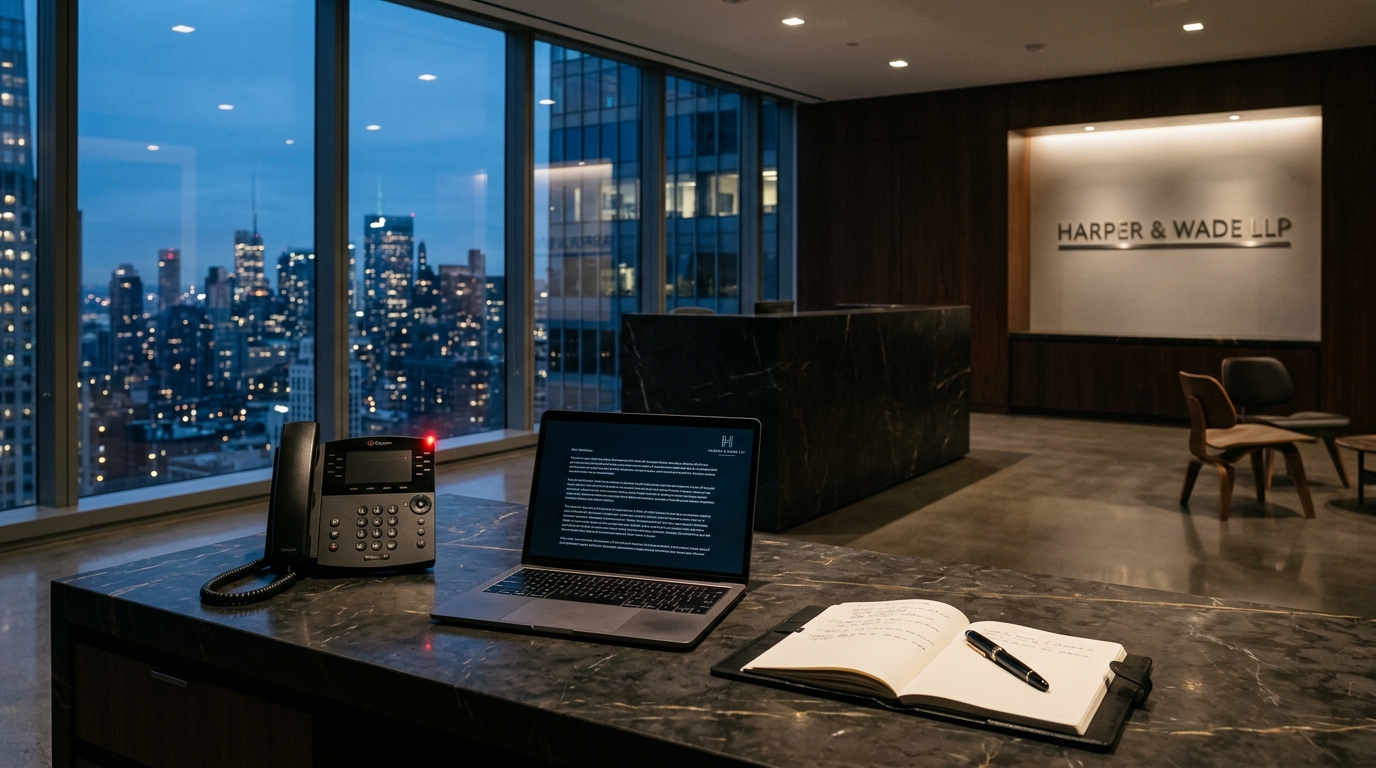
In nearly every service business—from high-growth legal practices and multi-clinic healthcare networks to commercial contracting firms—the front desk is quietly accepted as a fixed operational expense. An employee sits in the lobby, answers ringing phone lines, schedules consultations, and juggles administrative tasks. Because their base salary appears as a modest line item on your monthly profit and loss statement, leadership rarely scrutinizes the position.
That oversight is one of the most expensive blind spots in modern business operations. When you evaluate the true fully burdened financial footprint, human performance constraints, and the immense revenue lost to unanswered inquiries, a traditional front-desk receptionist frequently costs your firm hundreds of thousands of dollars each year in leaked enterprise value.
The Optical Illusion of the $45,000 Salary
Most business owners calculate the cost of a receptionist by looking strictly at direct payroll: roughly $22 to $25 per hour, or $45,000 to $52,000 annually. But direct payroll is merely the tip of the iceberg.
According to the Bureau of Labor Statistics and Society for Human Resource Management (SHRM), the fully loaded cost of an in-house employee in professional services averages 1.35x to 1.45x their base pay. When you factor in mandatory employer payroll taxes (FICA, FUTA, SUTA), group medical and dental insurance subsidies, workers compensation premiums, paid time off, and 401(k) contributions, that $45,000 employee immediately escalates to $63,000 in direct operational expenditure.
Then comes the hidden overhead: dedicated workstation physical footprint in premium office space ($3,500/yr), commercial enterprise software licensing ($1,800/yr for VoIP, CRM seats, and scheduling tools), office hardware depreciation ($1,200/yr), and supervisory management overhead. When a receptionist leaves—and front-desk roles exhibit an industry-wide turnover rate exceeding 38% annually—recruiting, background screening, onboarding, and productivity downtime cost an average of $4,129 per replacement cycle according to SHRM benchmarks.
Before a single telephone call has even been answered, your baseline investment in that single seat sits at $72,000 to $78,000 per year.
“A receptionist’s direct payroll is the smallest expense on the balance sheet. The catastrophic cost is the revenue that dies on hold and the calls that go straight to voicemail.
The Single-Channel Concurrency Trap
The fundamental structural defect of a human front desk is not compensation—it is physical bandwidth. A human operator is fundamentally a single-threaded processor. When Line 1 rings while your receptionist is checking in an in-person client, one of three things inevitably occurs:
- Line 1 rolls to voicemail: The prospective client hangs up and calls a competitor immediately.
- Line 1 is placed on hold: Over 67% of callers placed on hold longer than 45 seconds hang up in frustration.
- The in-person client is rushed: The receptionist is divided and flustered, compromising executive first impressions on both fronts.
Data across 1.4 million inbound commercial service calls compiled by industry analytics firms reveals a brutal consumer reality: 67% of callers who are placed on hold for longer than 45 seconds hang up. More critically, 85% of callers whose calls roll to voicemail do not leave a message. They immediately hang up and click the next sponsored link in Google search results, handing their business directly to your competitor.
If your company generates 50 inbound calls per business day, a standard 12% to 18% missed-call or hold-abandonment rate means 6 to 9 potential clients slip through your fingers every single day. If your average client value is $2,500 and your close rate on qualified inquiries is 25%, losing just two qualified leads per week equates to $260,000 in forfeited top-line revenue annually.
The Speed-to-Lead Decay Curve
In modern commerce, consumer psychology has shifted irrevocably toward instant gratification. Landmark research published by the Harvard Business Review and verified across modern sales engagement studies demonstrates that firms that contact inbound leads within five minutes of an initial inquiry are nearly 100 times more likely to connect and 21 times more likely to qualify that prospect compared to waiting just 30 minutes.
What happens in a traditional office when a prospective high-value client calls at 12:15 PM during lunch break, or at 5:15 PM after the office has closed, or on a Saturday morning? The inquiry sits in a digital voicemail box or an unread email inbox until the following business morning. By the time your staff dials the prospect back at 9:30 AM Monday, that lead has already booked an assessment or retained a competitor who answered their call instantly over the weekend.
A 9-to-5 front desk leaves your front door unlocked for only 40 out of 168 hours in a calendar week. For the remaining 128 hours—over 76% of every single week—your business is functionally closed to inbound revenue.
Human Inconsistency vs. Deterministic Precision
Even when your receptionist is present, energetic, and at their desk, human performance fluctuates naturally. On Monday morning after a stressful weekend commute, an employee’s tone of voice, cadence, and patience differ dramatically from Friday afternoon. Subtle cues—a hurried tone, an unenthusiastic greeting, or forgetting to ask a crucial qualification question—can torpedo a high-value opportunity in the first seven seconds of conversation.
Furthermore, data entry errors in fast-paced front desks are routine. Misspelled client names, transposed telephone digits, missing notes in the CRM, and double-booked calendar slots cost organizations tens of thousands in operational friction, missed appointments, and executive frustration.
By contrast, an autonomous AI voice agent operates with deterministic consistency. It delivers the exact brand-aligned tone, asks every prerequisite qualifying question, adheres rigidly to your business logic, and synchronizes full conversational transcripts, audio recordings, and structured CRM payloads within 500 milliseconds of call completion.
The Autonomous Front Desk Economics: A Direct ROI Comparison
Let us examine the annual unit economics of a typical professional service firm handling 800 inbound calls per month with an average client lifetime value of $5,000:
Under the Traditional Human Receptionist Model: Base salary ($48,000) + benefits, taxes, and software seats ($24,000) + estimated missed-call revenue leakage at 14% abandonment across 112 monthly missed calls, converting 5 closed deals lost ($300,000) = Total Annualized Economic Drag: $372,000.
Under the ZenAgentic Autonomous Voice AI Model: Enterprise implementation and dedicated infrastructure ($15,000 to $25,000) + zero payroll taxes, zero turnover cost, 24/7/365 coverage across all 168 hours weekly, unlimited concurrent call concurrency, and instantaneous CRM calendar synchronization = Total Annualized Cost: Under $30,000.
The net financial impact is not merely a $42,000 savings on administrative payroll—it is the recapture of $300,000 in previously abandoned enterprise revenue, delivering a measurable ROI exceeding 10x in the first twelve months.
The Hybrid Evolution: Elevating Staff from Message-Takers to Operators
The objective of deploying voice AI is not to depersonalize your business; it is to eliminate low-leverage friction so your human team can focus on high-value execution. When repetitive tier-1 tasks—answering pricing questions, screening for budget eligibility, collecting basic contact info, and booking calendar links—are handled autonomously by AI, your staff is liberated from constant telephone interruptions.
Instead of spending 6 hours a day acting as human switchboards, your administrative professionals can become high-touch client success managers, overseeing case files, coordinating field crews, and nurturing closed accounts. You transform a cost center into a profit multiplier.
“Autonomous AI front desks do not sleep, never take sick days, and never place a qualified prospect on hold. In an era where responsiveness equals retention, that is the ultimate competitive moat.
Conclusion: The Strategic Imperative for Modern Firms
Every time your phone rings and rolls to voicemail, you are paying a voluntary tax on inefficiency. In 2026, relying on a single human operator to guard the front door of a multi-million-dollar enterprise is an unacceptable operational vulnerability.
Forward-thinking organizations have already transitioned to autonomous voice infrastructure. They capture every after-hours emergency, qualify every lead against rigorous budget thresholds before booking executive time, and deliver flawless brand experiences on every ring. The math is indisputable: your traditional front desk isn’t just your most expensive employee—it is the single largest bottleneck holding your firm back from compounding growth.
Writing on autonomous voice infrastructure, enterprise operations, and systematic AI deployment for high-growth businesses.